


Assuming the management of the health and safety of your company through an Own Prevention Service (OPS) is a logical step when the volume of workers grows, but the bureaucratic complexity of the Law 31/1995 can be overwhelming.
With structured planning and the technological support of Prodity, it is possible to make this transition in just 180 days, ensuring full legal compliance and transforming an obligation into a competitive advantage.

Why take the leap to the Own Prevention Service now?
The decision to set up an OPS is not always optional, but it is always a strategic opportunity to improve the preventive culture.
The 500-worker threshold and legal exceptions
According to RD 39/1997, companies with more than 500 workers are obliged to set up an SPP. However, if your activity is included in Annex I (special risk activities such as mining or explosives), this obligation is reduced to companies with more than 250 workers.
Benefits: Control of claims and cost reduction
Internalizing prevention allows an immediate response to incidents. By knowing the company’s DNA, the Prevention Service Manager can design much more surgical measures than an outside service, which translates into a direct reduction of the work-related accident rate and an optimization of insurance premiums.

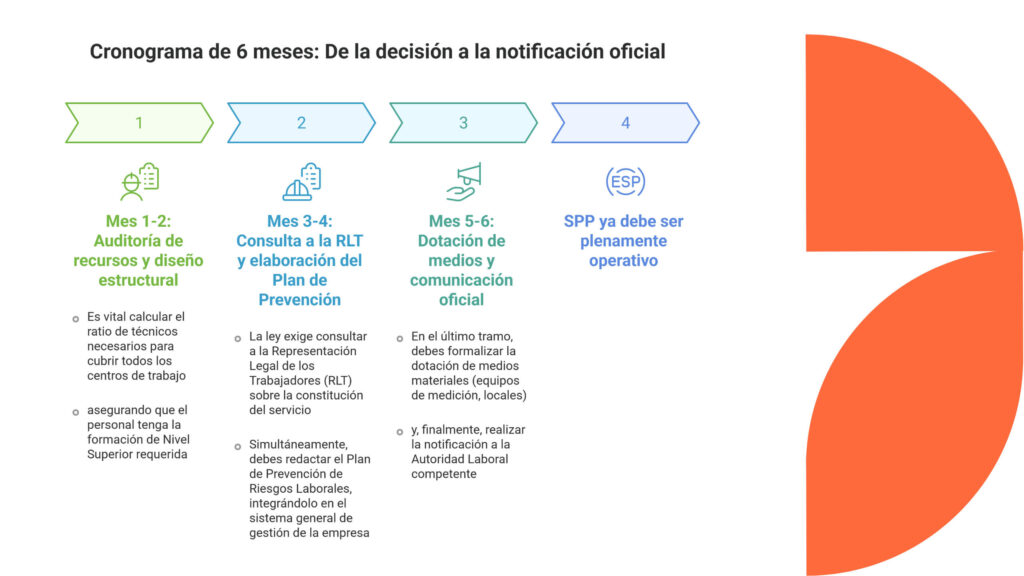
6-month schedule: From decision to official notification
Setting up an OPS is not an administrative process; it is an organizational engineering project. Prodity is integrated into this schedule to ensure that each milestone is met without manual errors.
Phase 1 (Month 1-2): Resource audit and structural design
During the first 60 days, you must define which specialties you will take on (Safety, Hygiene, Ergonomics or Health Surveillance).
Prodity’s boost: From month 1, our platform allows you to centralize the inventory of work centers and professional categories, facilitating the calculation of the ratio of technicians needed.
Phase 2 (Month 3-4): RLT Consultation and Prevention Plan
The law requires consultation with the Legal Representation of Workers (LRW). Simultaneously, you must draw up the Occupational Risk Prevention Plan.
- True integration: With Prodity, the Prevention Plan ceases to be a static PDF and becomes a digital workflow where responsibilities are assigned and monitored.
Phase 3 (Months 5-6): Media allocation and official communication
Formalization of material means and notification to the Labor Authority.
Immediate operability: At month 6, thanks to the previous digitalization, your OPS is born with all its history loaded: risk assessments, PPE deliveries and training plans ready to be audited.
Essential technical requirements to avoid failure
For your OPS to be validated in a labor inspection, it must meet two fundamental pillars:
- Qualifications and specialization: The service must have at least two preventive specialties developed by Senior Level Technicians.
- Functional independence: Technicians must have guaranteed independence with respect to other hierarchical functions in order to act with strictly professional criteria.
Common mistakes when internalizing prevention
Many SPP projects fail or are penalized for two main reasons:
- Lack of integration: Treating the OPS as an administrative island instead of integrating it into production processes.
- Analog document management: Trying to control the prevention of thousands of employees with spreadsheets. Fragmentation of information is the number one enemy of occupational safety.

Digitalization as a driver of OPS
Setting up an OPS means exponentially multiplying the volume of data: risk assessments, PPE deliveries, training and medical examinations. Technology is not a luxury, it is the necessary infrastructure. Prodity allows the Prevention Manager to stop being a paper manager and become a risk analyst, allowing management to make decisions based on real-time indicators.
Conclusion: Your success checklist
To set up your OPS in 6 months, make sure to:
- Define the model (Own or Joint) according to your corporate structure.
- Hire technicians with the specialties required by RD 39/1997.
- Digitize management with Prodity from day one to avoid administrative chaos and ensure scalability.
Want to ensure that the transition to your Proprietary Prevention Service is seamless? Schedule a demo of Prodity and discover how our platform automates the legal compliance and technical management of your new PPS.

Frequently Asked Questions (FAQ)
Which companies are obliged to set up their own Prevention Service?
Companies must set up an SPP if they have more than 500 workers, or more than 250 if they carry out special risk activities (Annex I of RD 39/1997).
What is the difference between a OPS and a Joint Prevention Service?
The Own Prevention Service belongs to a single company, while the Joint Prevention Service is shared by several companies of the same group or sector.
How does Law 31/1995 affect the structure of a OPS?
The Law on Occupational Risk Prevention requires the OPS to have sufficient human and material resources to cover all the company’s preventive activities.
What is the recommended ratio of prevention technicians per worker?
There is no fixed legal ratio in Spain, but the Labor Inspectorate usually recommends one senior technician for every 250 to 500 employees, depending on the hazard.
How does Prodity facilitate the management of an Own Prevention Service?
Prodity centralizes all preventive documentation in the cloud, automating health surveillance, PPE delivery and compliance with Law 31/1995.