

It’s December 2025. If you’re in charge of ORP or EHSQ, you know exactly what that means. While the rest of the departments are thinking about company dinners and Christmas hampers, you’re buried under a mountain of spreadsheets, sustainability reports, pending audits and strategic planning for 2026.
The end of the year is usually synonymous with stress, overtime and the constant feeling that something is slipping away. But what if I told you that this year could be different?
If you think you don’t have time to tackle everything the year-end close requires, it’s most likely not a time management problem, but a tooling problem. It’s because you’re not yet taking advantage of the potential of AI-powered EHSQ Software.
Below, we break down the 3 critical actions you need to execute before December 31 and, more importantly, how technology can do the hard work for you so you can focus on making decisions.
1. EHSQ Data Consolidation and Reporting: Goodbye Excel
The first big challenge at year-end is data collection. You need to know what has happened in the last 12 months: frequency rates, severity, training provided, waste management and legal compliance.
Traditionally, this involves chasing down plant managers, consolidating dozens of Excels in different formats and diving into endless folders to find that specific piece of data that is asking for direction.
This manual process is not only time-consuming, it is the number one enemy of effective ORP Digitization.
How AI changes the rules of the game
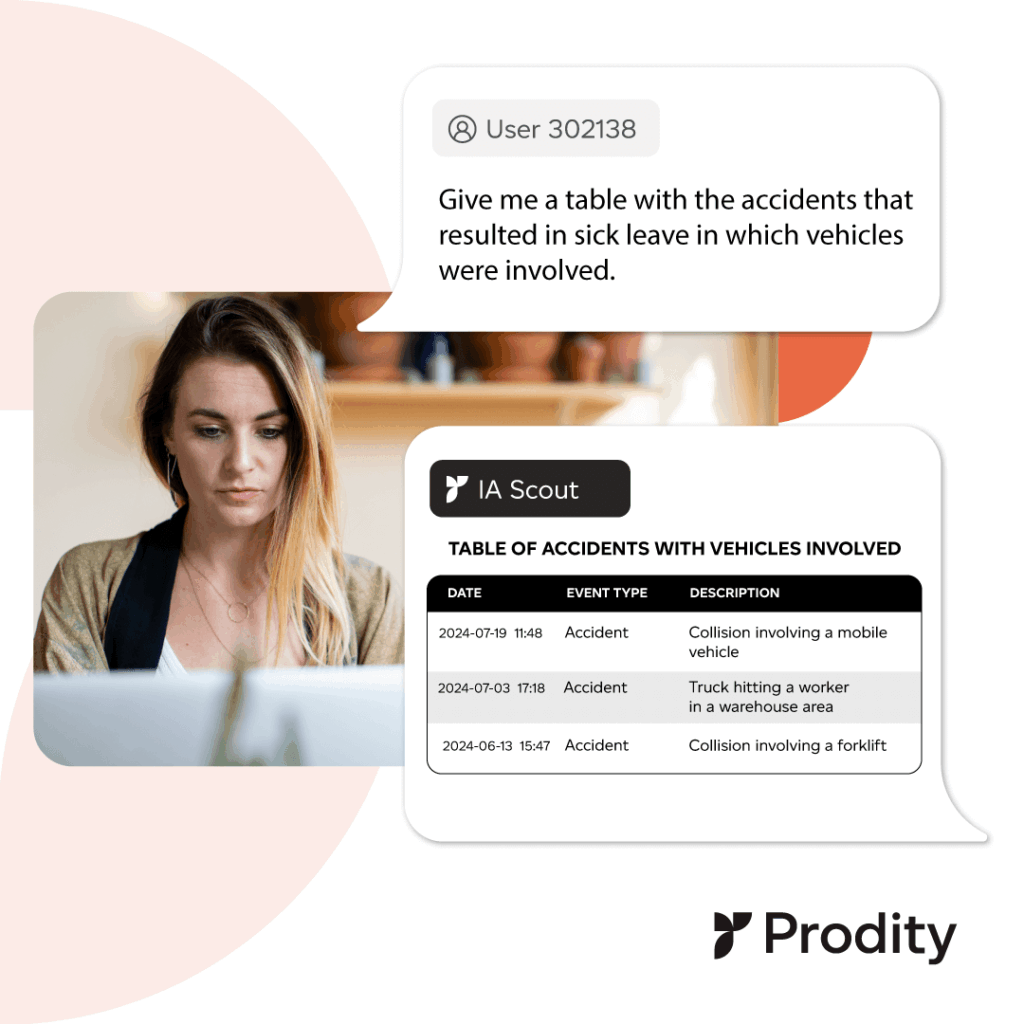
Imagine an assistant who knows every nook and cranny of your database. Advanced EHSQ software like Prodity transforms the search for information into a fluid conversation.
- Data exploration with AI Scout: Forget about complex filters and endless pivot tables. Thanks to AI Scout, you can interrogate your data with simple questions in natural language. Need to know “how many height incidents there were in Q3” or “what is the status of corrective actions at the North plant”? You simply ask, and the AI scans all the information to give you the exact answer instantly.
- One-click reporting: Instead of spending weeks on the layout of the annual sustainability report or preventive report, the technology uses this structured data to draft and visualize trends in seconds.
The result: You go from spending time “searching” for information to spending time “understanding” what is going on in your organization.
2. Trend Analysis and Predictability: Looking Beyond the Rearview Mirror
Most year-end closings focus on reactive analysis: What accidents did we have and why did they occur? While this is necessary for incident investigation, staying there is a strategic mistake.
To lead in safety and health, you need to anticipate. You need to know where the next incident will happen before it happens. This is where Digitalization ORP comes into its own.
The power of predictive data
By using AI tools integrated into your management platform, you can cross-reference variables that would take a human months to correlate.
- Hidden pattern detection: Do minor incidents increase on the night shift when the ship’s temperature drops below a certain degree? The AI detects it.
- Automatic generation of action plans: Don’t be left alone in the diagnosis. Once the risks have been identified, the AI proposes concrete preventive actions and issues automatic alerts to those responsible for reducing incidents. The system works for you, suggesting a solution before the problem escalates.

3. Strategic Planning 2026: Objectives Based on Reality, Not Assumptions
The third key action is to define the Prevention Plan for the coming year. Often, these plans fail because they are based on a mixture of intuition and “do the same as last year, but a little better”.
For your strategy to be effective, it must be born from clean data. And this is where many companies stumble: if your source data (such as thousands of accumulated Preventive Safety Observations or PSOs) has been processed manually, it is likely to carry subjective biases or errors of interpretation.
How AI sharpens your strategic aim
Modern EHSQ software uses AI to clean up that noise before you start planning.
- Elimination of bias in analysis: Before deciding where to invest, AI can massively process the history of your PSO to tell you what the real risks are, not what we “think” they are. This is the approach that allowed industrial organizations like Tubacex to drastically reduce management times and eliminate subjectivity in their safety analysis. By having an automatic and pure diagnosis, they were able to focus their resources where it really hurt(see how they applied this methodology here).
Why continuing to work “the old way” is a risk for your business
Resistance to ORP Digitalization is no longer a conservative choice; it is a risky one. In an environment where ESG regulations are increasingly demanding and the supply chain demands full transparency, relying on manual processes is unsustainable.
An EHSQ Software is not just a pretty database. It is your command center. It is the difference between arriving at the end of the year exhausted and with doubts about the veracity of your data, or arriving at the end of the year calm, with everything under control and with a clear strategy for the future.
Prodity doesn’t just store your data; it activates it through AI to protect your team and legally shield your company.
Ready to transform your management in 2026?
This year-end, give yourself peace of mind and efficiency. Don’t let bureaucracy slow down your impact on the organization.
If you want to learn more about how to apply these strategies and see real examples of companies that have achieved operational excellence:
Download now the Tubacex Case Study and take away the digitalization road map
Or if you prefer to see how our AI can work with your specific data, request a personalized demo of Prodity today.

5 Frequently Asked Questions about AI in EHSQ and ESG Management
Below, we answer the most common questions that ORP managers often ask of AI tools.
1. How does an EHSQ Software improve the profitability of my company?
EHSQ software drastically reduces operating costs by minimizing administrative time (up to 40% less reporting time) and reducing claims through risk prediction. In addition, it avoids penalties for non-compliance and improves corporate reputation, which facilitates access to tenders and green financing (ESG). It is an investment that pays for itself through efficiency and the prevention of unplanned downtime.
2. Is it safe to upload sensitive ORP data to an AI in the cloud?
Yes, as long as the provider complies with strict standards such as ISO 27001 and GDPR. Professional ORP Scanning uses advanced encryption and secure servers. Unlike an Excel saved on a local hard drive or sent by email (which is highly vulnerable), a cloud software guarantees automatic backups, access traceability and enterprise-level cybersecurity to protect workers’ medical and personal data.
3. Can AI predict workplace accidents before they happen?
AI is not a crystal ball, but predictive analytics comes very close. By processing large volumes of historical data (near misses, unsafe conditions, fatigue, schedules), algorithms identify correlations invisible to the human eye. This allows EHSQ Software to issue early warnings about areas or processes with a high probability of incident, allowing technicians to intervene preventively rather than correctively.
4. What role does ORP digitalization play in ESG compliance?
Fundamental. ESG (Environmental, Social and Governance) criteria require auditable and transparent data. Digitization ensures the integrity of this data from the source. AI facilitates the collection of carbon footprint, diversity and workplace safety metrics, and automates the creation of sustainability reports under standards such as GRI or SASB, ensuring that the company not only complies, but leads in corporate responsibility.
5. Is it difficult to implement AI software if my company is traditional?
Not necessarily. Modern solutions like Prodity are designed with user experience (UX) in mind, making them intuitive. The key to ORP Digitalization is not technological complexity, but change management. A staggered implementation, accompanied by training and support, allows even companies with very analog processes to adopt the tool quickly, seeing benefits from the first weeks of use.