Sections of the guide
DS 132 isn’t just for large mining companies—and that’s exactly the problem
There’s a widespread misconception in the industry that needs to be debunked from the outset: that DS 132 applies only to large copper operations, open-pit mines with thousands of workers, and mining companies with legal departments and risk management teams. It’s a convenient—and mistaken—notion.
The Mining Safety Regulations apply to the mining industry as a whole in Chile: medium-sized mining sites, small companies with service contracts at larger operations, drilling contractors, and maintenance companies working at third-party sites. If your company places a worker at a mining site—directly or indirectly—DS 132 applies to you.
The problem isn’t that we’re unaware the regulation exists. The problem is not knowing precisely what it requires in practice, how it differs from DS 594—which you’re already familiar with—what exactly that “Sernageomin Book” mentioned in the audit is, and how to document all of that in a way that will stand up to an audit. This guide addresses exactly that.

What is DS 132, and to whom exactly does it apply?
Supreme Decree No. 132 of the Ministry of Mining, published in the Official Gazette on February 7, 2004, is Chile’s Mining Safety Regulation. It establishes the regulatory framework to which all mining operations must adhere in order to protect the lives and safety of workers, facilities, and the environment. The responsibility for implementing it and enforcing compliance rests with Sernageomin.
To whom does it apply? To any individual or legal entity that operates, manages, or performs work at a mining site. This includes:
- Principal mining company: the concession holder or owner of the mining site. It is the primary entity responsible and accountable to Sernageomin for the entire operation.
- Contractors and subcontractors: Any company providing services on the site is subject to DS 132. Their safety observations are recorded in the same Sernageomin logbook as the principal operator’s— they do not maintain their own logbook.
- In-house and third-party workers: The regulation protects everyone working on the premises, regardless of their employer.
The regulation expressly distinguishes between a “Mining Company” ( principal) and a “Contractor Mining Company, ” and governs the relationship between the two. There is no gray area: if you operate at a mining site, this regulation applies to you.
Exclusions: oil refineries, steel mills, glass factories, cement plants, brick factories, and similar facilities are not considered mining operations for the purposes of these regulations.
DS 594 vs. DS 132: When Does One Apply, When Does the Other, and When Do Both?
This is the question that causes the most confusion in the field, especially among contractors who work interchangeably at mining sites and industrial facilities.
The short answer: In a mining operation, both are applied simultaneously and complementarily. DS 594 is not replaced—it is superimposed.
| Criterion | DS 594 | DS 132 |
|---|---|---|
| Scope | All workplaces in Chile | Exclusively the mining industry |
| Regulatory Agency | Labor Directorate (DT) | Sernageomin |
| Main focus | Basic health and environmental conditions | Operational safety at mining sites |
| Application in Mining Operations | Yes, for everything not regulated by DS 132 | Yes, as a specific and preferential regulation |
| Official logbook | Does not require a specific inspector’s logbook | Sernageomin logbook (mandatory) |
| Prevention expert | Occupational Safety and Health Expert under Law 16,744 | Expert in Prevention in the Mining and Extractive Industries (Categories A, B, C) |
| Notice of commencement | Not applicable | Required: 15 days before the start of construction |
| Specific internal regulations | General internal regulations | Site-specific regulations for critical operations |
The key operational principle: DS 132 takes precedence in all matters it specifically regulates. Where DS 132 is silent (such as living conditions in camps or office lighting, for example), DS 594 applies. Safety officers at mining sites need to be thoroughly familiar with both—and know when each one applies. To learn more about the general regulatory framework, check out our guide on Law 16,744 and DS 594 in Chile.
The Sernageomin Manual: What It Is, What It Must Contain, and Who Is Responsible for It
The Sernageomin Register is probably the most tangible element of DS 132 in the daily life of a disaster prevention specialist. It is also the one that causes the most headaches during an inspection if it is not in order.
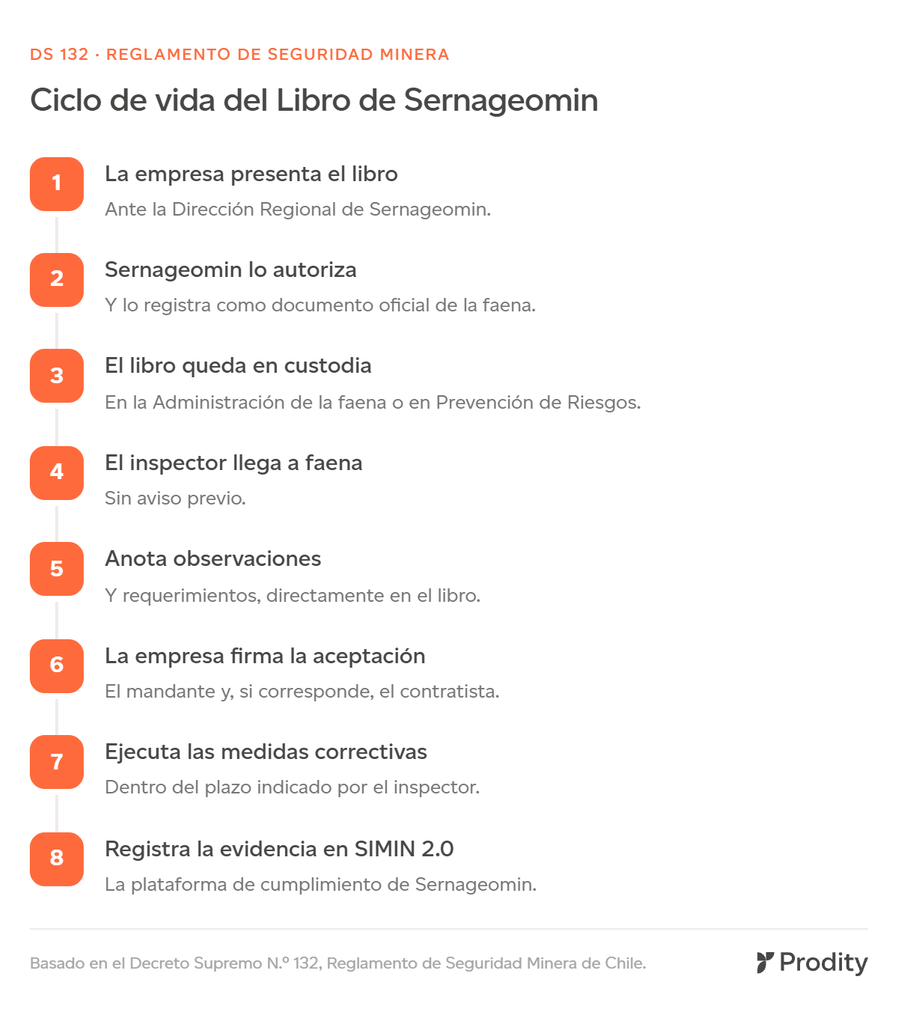
What it is: an official, paginated register with copies, where Sernageomin officials record all observations and requirements arising from their inspections of the site. It is not a record that the company drafts and controls—it is an official report written by the inspector, and the company signs it to acknowledge receipt. The company cannot modify what the inspector notes or decide which observations are recorded.
Features You Should Know About:
- One logbook per job site. Even if a client company has multiple contracts with different companies working simultaneously, there is only one logbook for the entire job site. Comments directed at contractors are also recorded there.
- Prior authorization is required. Before use, the book must be submitted to the appropriate Sernageomin Regional Office, indicating the name of the responsible executive and the site expert. It is officially valid only once it has been authorized and registered.
- Where it must be kept: at the site’s administration or management office, or in the Risk Prevention Department, if one exists. It cannot be stored at a central office off-site.
- Signature of Acceptance: At the end of each entry, the representative of the client company (and of the contractor, if the observation applies to them) must sign to indicate acceptance of the information recorded. A copy is retained by Sernageomin.
- Response Deadlines: Observations and corrective actions must be implemented and addressed within the timeframes specifically indicated by the Service. Failure to comply will result in consequences.
- Evidence of Compliance: Companies may submit evidence of compliance through Sernageomin’s SIMIN 2.0 platform.
Who is responsible: The principal company is primarily responsible for keeping the logbook in good condition and responding to observations within the specified timeframe. If the observation concerns a contractor, both companies sign—and the principal company remains responsible for overall compliance.
What happens if the logbook is missing: During an audit, the absence of the logbook or the fact that it is out of date is an immediate finding. Sernageomin may record the finding of noncompliance in the logbook itself—and if previous deadlines were not met, the accumulation of noncompliance increases the severity of the penalties.
Joint Committee at Mining Sites: What Has Changed Compared to the General Regime
The Joint Committee on Health and Safety in Mining operates under the same legal framework (Law 16,744 and Presidential Decree 54), but Presidential Decree 132 assigns it a specific role in the context of Sernageomin inspections.
The most significant difference in practice: Sernageomin may be accompanied by one or more members of the Joint Committee during its inspections (Art. 18 of DS 132). This gives the committee direct insight into the inspector’s observations, access to the Sernageomin Logbook, and the ability to request the Service’s intervention when there is no agreement with the administration.
In addition, when a workplace is not required to establish a Joint Committee (based on the number of workers), workers may still request a joint inspection from management. If no agreement is reached, they may directly request Sernageomin’s intervention in writing —and the outcome is recorded in the logbook.
In practice, this means that the committee is not merely an internal body: it can trigger action by the regulator. A poor relationship with the joint committee can result in an unscheduled audit.
Sernageomin Inspections: What They Check, What They Find, and What Happens When There Are Problems
Sernageomin has the authority to inspect and evaluate all facilities at a mining site at any time and without prior notice, as often as the agency deems necessary. The company is required to grant access and to have personnel with decision-making authority and knowledge of the operation available to assist the inspectors.
What they typically check during an inspection:
- Status and availability of the Sernageomin Logbook (Is it in use? Is it authorized? Have previous observations been addressed in a timely manner?)
- Compliance with internal regulations for critical operations (blasting, lifting, working at heights, confined spaces, among others)
- Status of equipment, machinery, and facilities
- Management of explosives and hazardous materials
- Ventilation conditions in underground mining
- Declaration of commencement of work and mandatory notifications to the Service
- Accident records (forms E100, E200, E300 on the SIMIN platform)
- Compliance with Corrective Actions from Previous Inspections
Most Common Penalties: Failure to comply with the observations recorded in the Sernageomin Log within the established timeframe is the most frequent grounds for penalties. Fines can be substantial, and in cases of imminent risk to workers, Sernageomin has the authority to suspend operations. A history of noncompliance leads to harsher penalties in subsequent rulings.
A company with incomplete records, unanswered observations, or procedures lacking traceability faces a high risk of penalties—even if the physical condition of the worksite is satisfactory. Information management is just as important as the actual working conditions. To better understand how to integrate risk assessment using ISO 31010 methodologies in this context, we recommend reviewing this article from the cluster.
How EHSQ Software Facilitates Compliance with DS 132 in a Traceable and Auditable Manner
DS 132 generates a large volume of records and documentation that, when managed on paper or in scattered spreadsheets, pose an operational risk in and of themselves. When Sernageomin arrives at a worksite, the safety officer needs to access the following within minutes: previous entries in the logbook, the compliance status of each corrective action, internal inspection records, staff certifications, and active work permits. In an operation with multiple contracts and several simultaneous job sites, this is unmanageable without a centralized platform.
Prodity is an EHSQ + ESG software solution that helps organizations comply with DS 132—it does not impose its own methodologies or frameworks, but rather digitizes and streamlines the processes already required by the regulation, making them traceable and auditable in real time. The most relevant modules for the mining sector are:
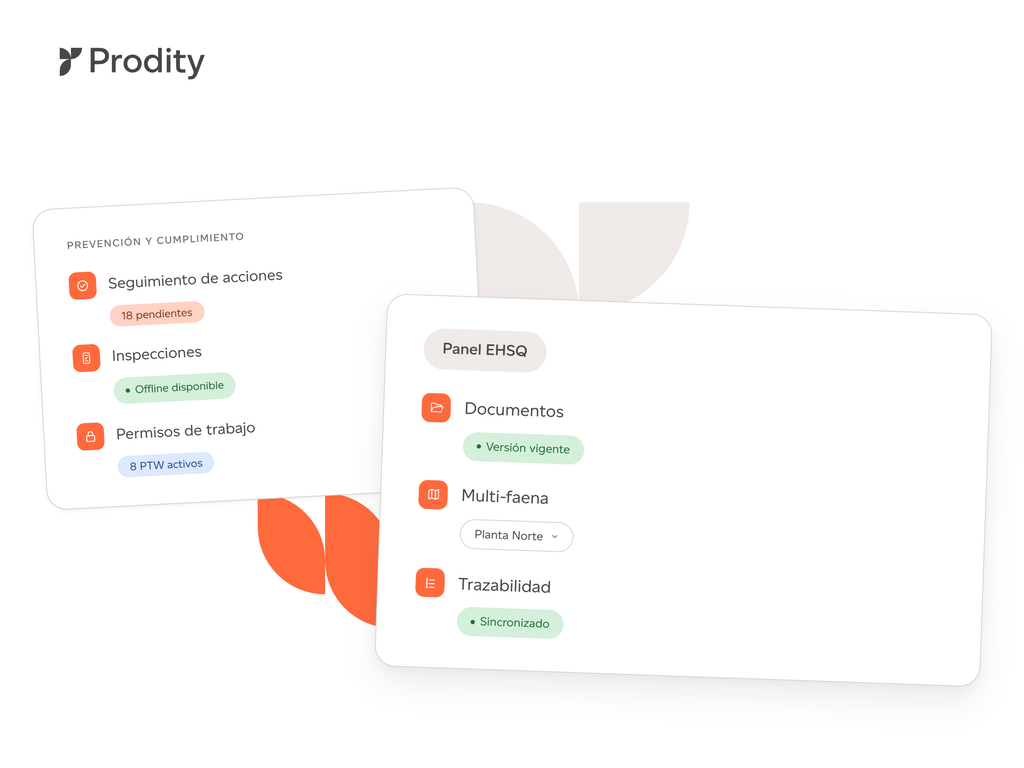
- Corrective Action Tracking: Centralizes the tasks arising from each Sernageomin observation, including deadlines, email alerts for upcoming deadlines, and progress logs with photographs. It allows responsibilities to be assigned to both internal staff and external contractors—the entire client-contractor chain within a single workflow.
- Digital on-site inspections: configurable checklists run from a mobile app that works 100% offline. Photos are automatically attached, and the inspector collects participants’ handwritten signatures directly on the screen.
- Work Permits for Critical Operations: digitizes PTW approval workflows, automatically verifies whether workers have valid training, integrates with LOTO/LOTOTO procedures, and records digital signatures on-site before the operation begins.
- Document management with validity control: a single cloud-based repository that eliminates obsolete versions, notifies staff of changes, and records read receipts with mobile handwritten signatures. Procedures are accessible from the worksite via a QR code.
- Multi-Task Management and Dashboard: Centralizes real-time information on all active tasks, eliminates the need for manual reports, enables cross-departmental benchmarking based on standardized criteria, and provides dashboards with predictive and reactive indicators.
- Audit Traceability: Generates PDF reports instantly and maintains an audit log synchronized to AWS’s hourly precision. The electronic signature is validated by external auditors as a substitute for the paper format.
Companies in the industrial and energy sectors , such as Colbún, Salfa, and Grenergy, already manage their EHSQ obligations with Prodity. The platform is designed to handle the operational complexity of the mining sector —whether in large-scale operations with multiple simultaneous sites or in medium-sized companies with more streamlined safety management structures.
Ya confían en Prodity en Chile…
Would you like to see how Prodity adapts to EHSQ management at mining sites?
If you manage safety in the mining industry or handle contracts within the sector, we’ll show you in 30 minutes how Prodity can help you comply with DS 132 in a traceable and auditable manner.
To learn more about the general regulatory framework for occupational safety and health in Chile, see our guide on occupational risk management in Chile and the article on Law 16,744 and Presidential Decree 594.
Frequently Asked Questions About the DS 132 Sernageomin
Does DS 132 also apply to contractors working at mining sites?
Yes, directly. The regulation expressly distinguishes between the principal company and the contractor, and both are subject to its requirements within the mining site. Safety observations directed at a contractor are recorded in the principal company’s Sernageomin logbook—there is no separate logbook. This means that the contractor’s compliance record is documented in the file of the company that contracted the service, creating a shared responsibility that should be actively managed.
What happens if Sernageomin conducts an inspection and the logbook isn’t up to date?
Failure to keep the Sernageomin Log up to date— unanswered observations, expired deadlines, unsigned entries —is one of the most common grounds for penalties. The inspector can document the noncompliance in the Log itself and set new deadlines with associated penalties. If there is a history of repeated noncompliance, the severity of the ruling escalates. In cases of imminent risk, Sernageomin has the authority to order the suspension of operations. Systematic follow-up on each observation and proof of its resolution is, in practice, the best protection against an audit.
How does the joint committee at a mining site differ from that of a typical industrial company?
The legal basis is the same (Law 16,744 and Presidential Decree 54), but Presidential Decree 132 assigns an additional role to the Joint Committee on Mining: may accompany Sernageomin on its inspections and its members have direct access to the Sernageomin Register. Furthermore, even at work sites where there is no requirement to form a committee (due to the number of workers), the workers’ representatives They can request the Service’s assistance directly if the administration fails to address their safety concerns. In practice, the joint mining committee has more formal channels for escalating issues to the regulator than its counterpart in the general industrial sector.
How is the Sernageomin Logbook managed in companies with multiple simultaneous projects?
Each site has its own Sernageomin logbook —they cannot be consolidated into a single record. A company with four active sites must maintain four separate logbooks, each authorized by the corresponding Regional Office, each with its own history of observations and responses. In practice, coordinating the monitoring of all these sites through centralized management is one of the main operational challenges for medium-sized contractors. Without a platform that centralizes corrective actions and their compliance status by site, there is a high risk that something will get lost between meetings and emails.
What records does DS 132 require that DS 594 does not?
The DS 132 features registration and reporting requirements that do not exist in DS 594: the authorization and registration of the Sernageomin Register with the Regional Office; the written notice to the Service at least 15 days in advance at the start or resumption of construction work; internal regulations for critical operations (blasting, lifting, work at heights, confined spaces, among others); the Forms E100, E200, E300 through the SIMIN platform; and the management of specific certifications for the Expert in Prevention in the Mining Industry. None of these elements exist as such in DS 594, which regulates general health and environmental conditions without these sector-specific procedural requirements.
Is DS 132 being updated? What does that mean for current management?
Yes. Since 2024, Sernageomin has been conducting a formal process to update DS 132 to incorporate automation technologies, new risk assessment methodologies, and international best practices. The current text remains the version published in 2004. What’s important for an EHSQ Manager is that a regulatory update will require a review of procedures, records, and management systems. Companies with a structured EHSQ platform adapt to this change much more quickly than those that manage compliance on paper or in silos.
How often can Sernageomin conduct inspections?
DS 132 does not establish a fixed inspection frequency. Sernageomin may conduct inspections as often as it deems necessary. Companies with a history of noncompliance or serious accidents are inspected more frequently. This makes continuous preventive management —not just reactive compliance in response to an announced inspection—the only consistent strategy. An EHSQ platform that generates evidence of day-to-day management automatically builds that compliance record, without relying on last-minute preparations.