


Article Contents:
If you work in EHSQ management, you may already be using AI for industrial safety in some part of your day-to-day work. Or you may be considering implementing it soon. Or you may still be managing much of this on paper or in an Excel spreadsheet that’s updated manually.
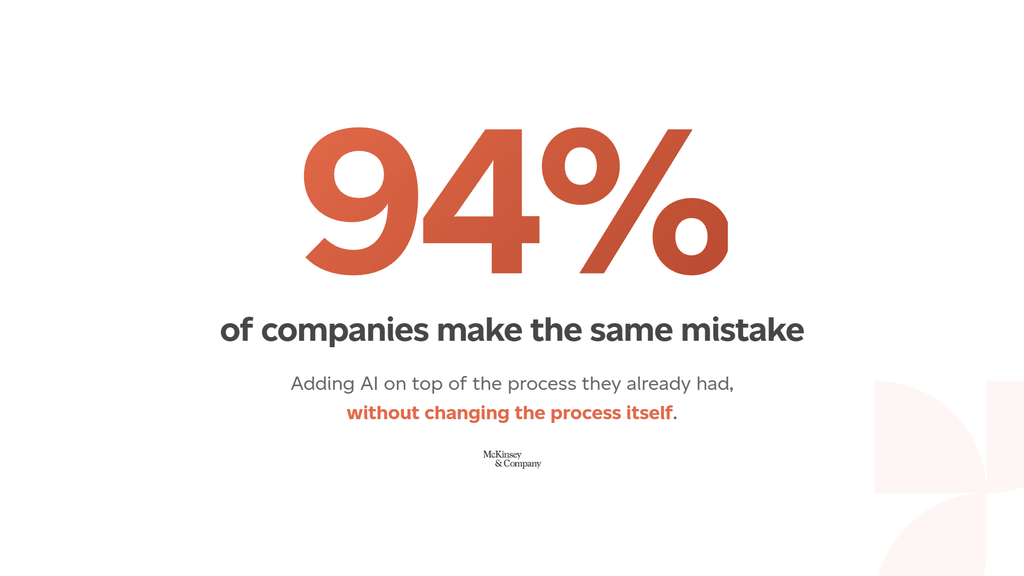
No matter where you’re starting from, there’s one piece of information you should check out before moving on: a recent McKinsey report (State of AI 2026) estimates that 94% of companies make the same mistake when implementing AI .
Add it on top of the process you already had, without changing the process itself. Same reporting workflow, same approvals, same manual steps—only now with a smart dashboard wrapped around it.
If you’re coming from paper or Excel, that’s exactly the mistake you might end up repeating when you go digital: you change the tool, but not the process.
And if you already have AI in place, it’s very likely that this is what’s happening to you right now, even if you haven’t noticed it. Because the issue isn’t whether you “feel” like you’re working better. It’s whether the accident rate goes down, whether you react more quickly to a risk, or whether it takes less effort to handle a nonconformity.
Let’s take a look at why this happens and how to do it differently, including a real-life example.
What Is AI in Industrial Safety, Really?
We’re not talking about robots or automated production lines here. We’re talking about systems that process safety data—incidents, audits, near-misses—which used to require hours of manual work: identifying patterns, generating action plans, and answering questions about safety conditions at a plant without having to search through an Excel spreadsheet.
When implemented correctly, this translates into two very specific benefits for an EHSQ department. The first is time: hours that a safety technician used to spend on administrative tasks and can now spend on the shop floor, where they truly add value. The second is peace of mind regarding compliance: when data is centralized, traceable, and always up to date, an audit is no longer a last-minute scramble to reconstruct what happened and when—it becomes something you’ve already thoroughly addressed.
When AI is just layered on top of the problem, instead of solving it
Most organizations do the same thing: they take the process they already had—same reporting chain, same approvals, same bottlenecks—and slap some AI on top of it. A slightly smarter dashboard. An alert that goes off sooner. A report that generates itself. None of that gets to the root of the problem.
And that’s the real catch: you can see the problem more clearly without solving it, because the flaw isn’t in the dashboard. It’s that no one has changed the way the team works around it. They’re still filling out the same form, escalating through the same channel, waiting for the same approval—only now with a prettier dashboard in the background. Without change management, AI remains nothing more than a visualization layer on top of the same old way of working.
How does this play out in the day-to-day work of an EHSQ manager?
You can tell right away if you know where to look:
- Tools that no one uses in the field. They’re designed in an office and handed off to field workers who are wearing gloves, have their hands full, and don’t have time to fill out a ten-field form. It doesn’t matter how good the AI behind it is if the field worker avoids the form.
- Dashboards that are empty at the top. If you don’t make it easy to enter data, the dashboard won’t be populated. It doesn’t matter what AI you put behind the analysis: without input data, there’s nothing to analyze.
- Reports that no one opens. It doesn’t matter how sophisticated the analysis is if the safety technician still has to download it, read the whole thing, and decide manually what to do with it. You’ve automated the generation of the problem, not the problem itself.
- Data that piles up without leading to anything. Incidents, near-misses, audits—all classified by AI. But if no one reacts any faster because of it, the data just sits there, serving no practical purpose.
Turn your EHSQ & ESG data into actionable insights with our AI
What Sets Companies That See Results Apart
McKinsey makes it quite clear: companies that do achieve an impact don’t simply fit AI into their existing processes. They redesign the process from the ground up with AI in mind. The question they ask isn’t “Where does AI fit into what we’re already doing?” but rather“If we had to build this from scratch today, how would we do it?”
That true redesign is only possible if AI is integrated into the system itself from the design phase, not added later as a plugin. Native AI has direct access to all the data and can act on the entire workflow. An AI layered on top, on the other hand, can only read what’s there and return a result—it doesn’t touch the underlying process. That’s why so many implementations remain merely “smarter” without actually becoming “truly faster.”
Redesigning with native AI, however, does not mean removing people from the process. AI suggests, prioritizes, and speeds things up; the decisions that really matter —stopping a job, imposing sanctions, changing a procedure—are still made by someone with good judgment. Removing the mechanical aspects is not the same as removing people.
When applied to occupational risk management, this translates into very specific outcomes: a system that detects risks and assesses data quality in real time, without anyone having to review it manually. Or being able to ask in natural language how safety is going at a plant, without having to generate a report, wait for someone to read it, and then make a decision.
Put that way, it sounds abstract. Let’s look at a concrete example.
An example of how this works in practice
This is the principle we follow when designing Prodity AI: each agent eliminates a step from the process, rather than just adding another layer on top of it. Here’s how that translates in practice:
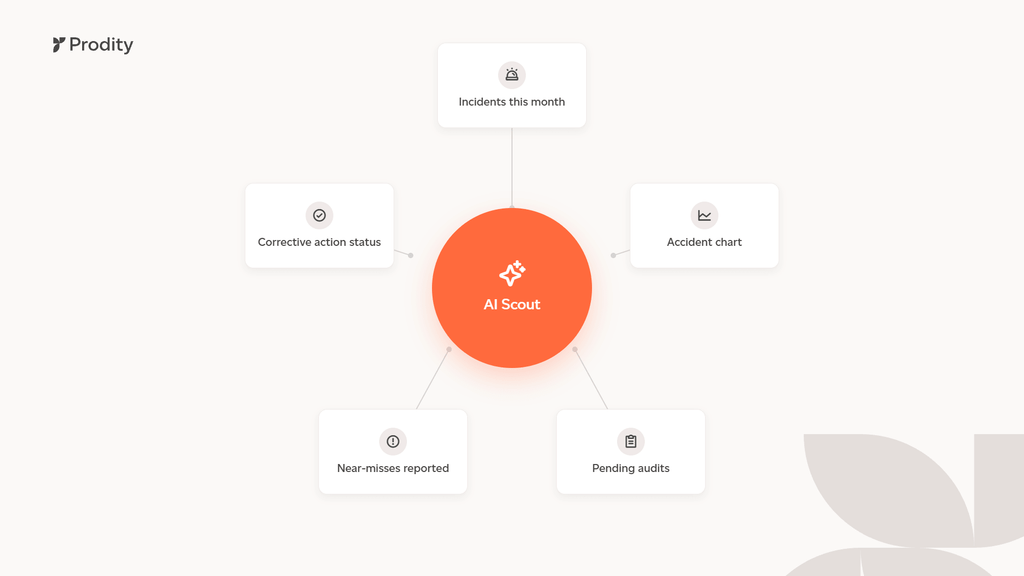
- AI Scout replaces manual data searches with natural-language queries. The “generate report → read it → decide” process is eliminated entirely.
- RelaTiQ searches for historical events similar to the one you’re managing, so you don’t have to start from scratch every time a new risk arises.
- Action Bot automatically drafts action plans, risk assessments, and lessons learned.
- Smart Play checks data quality and automatically detects risks before anyone has to verify it manually.
- Field Voice moves incident reporting to where the operator already is—WhatsApp—without the need for forms.
None of these agents make decisions on their own. They prioritize, issue alerts, and lay the groundwork, but the final say—whether to halt a task, terminate an action, or escalate a risk— still rests with a person. This is “human-in-the-loop” in its truest sense: not as a legal disclaimer, but as a design principle.
The difference with a 94% implementation isn’t that these agents “have AI.” It’s that each one handles an entire step of the process—it doesn’t just speed it up a little.
The Zelestra Case: From 2 Hours to 1 Minute
You don’t have to look far to see this in action. Zelestra faced the same problem as most EHSQ departments: hours of manual analysis before being able to act on safety data.
After redesigning the process using this approach, Zelestra’s HSE analysis went from 2 hours to 1 minute. And not because AI summarized reports more quickly, but because there was simply no longer any need to generate and read the report.
That’s the difference between 94% and 6%.
Are you in the 94% or the 6%?
Before adding another AI tool to your EHSQ stack, ask yourself these questions: Does it eliminate a step in the process, or does it just make it faster? If you removed it tomorrow, would everything go back to exactly the way it was before? Do people in the field actually use it, or do they avoid it whenever they can? Can you point to a business metric—not an adoption metric—that has changed in a measurable way?
If any of the answers made you uncomfortable, don’t worry: you’re part of the 94%, just like almost everyone else. What makes the difference isn’t switching tools—it’s redesigning the process.
They already trust Prodity…
Frequently Asked Questions
How do I know if my AI implementation in EHSQ is actually working?
Ask yourself four specific questions. First: Does AI eliminate an entire step from the process, or does it just make it a little faster? Second: If you removed it tomorrow, would the process go back to being exactly the same as before? If the answer is yes, nothing structural has changed. Third: Do people in the field—operators, plant technicians—actually use it, or does it only show up in office adoption reports? Fourth: Can you point to a real business metric—not usage or satisfaction—that has changed measurably since you implemented it? If you’d like to see how to apply this to your own occupational risk management, you can request a free demo and go over it with our team.
What sets apart the companies that actually achieve real impact with AI?
They redesign the process with AI in mind from the start, rather than simply inserting it into their existing workflow. They replace the cycle of generating a report, reading it, and making a decision with a system that detects risks or answers questions directly.
What does “human in the loop” mean in industrial safety?
It is a design principle in which a person remains involved in the decision-making process, rather than letting AI act completely autonomously. AI can analyze data, detect risks, or propose a course of action, but it does not independently execute decisions that have real-world consequences—such as halting a task, imposing a penalty, or changing a procedure. A person continues to validate those decisions. In industrial safety, this is particularly important because a system error is not simply a mislabeled data point: it can mean failing to act on a real risk, or generating so many false alarms that no one ends up trusting the system.