

Checklist for Evaluating EHS Software
Selecting the best EHS (Environment, Health and Safety) software is a strategic decision that can directly impact the safety, compliance and sustainability of any company. With so many options on the market, it is essential to know what to look for in order to make an informed decision. This article will help you compare alternatives and choose the tool that best suits your organization’s needs, especially if you operate in industrial or logistics environments in Spain.

Regulatory compliance
An EHS platform must be prepared to respond to the main regulatory frameworks in safety, health and environment. This includes the requirements of international standards such as ISO 9001, ISO 14001 and ISO 45001, current occupational health and safety legislation, as well as widely recognized sustainability standards such as the GRI indicators. Ensuring this regulatory alignment is not only an obligation, but also a solid basis for continuous improvement and corporate transparency.
Ease of use and implementation
The best EHS software is one that can be easily adopted by all user profiles, from technicians to management. An intuitive interface, integrated training and local support can make the difference. In addition, implementation should be agile, without complex technical processes or excessive IT dependencies.
Integrated process management
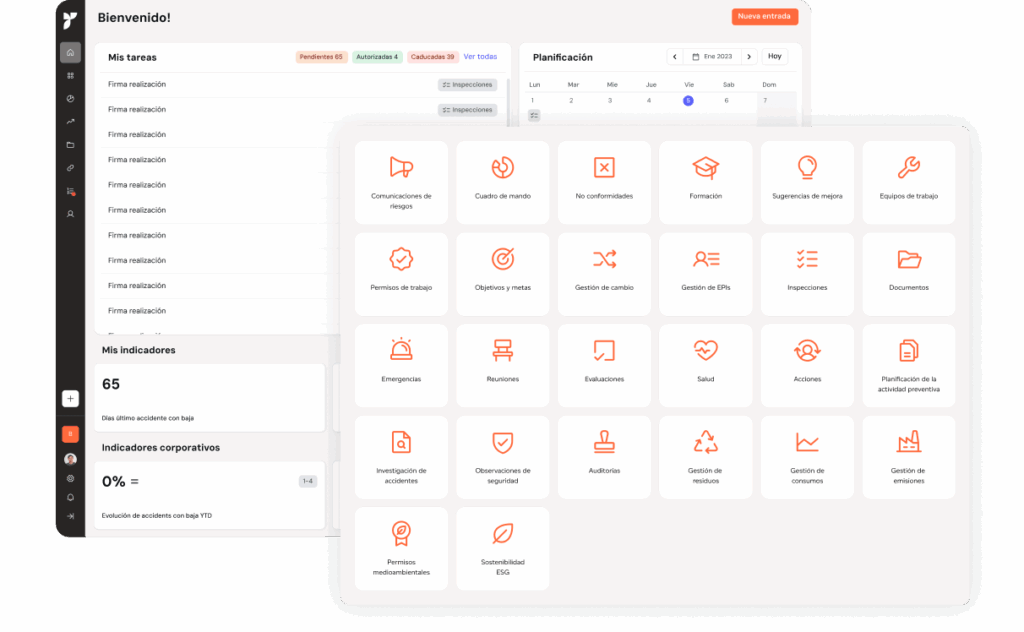
An effective EHS solution must cover all critical areas: waste management, audits, incidents, training, risk assessments, permits and more. Look for platforms that allow you to centralize all of this information in a single digital environment, with real-time visibility and automation of key tasks.
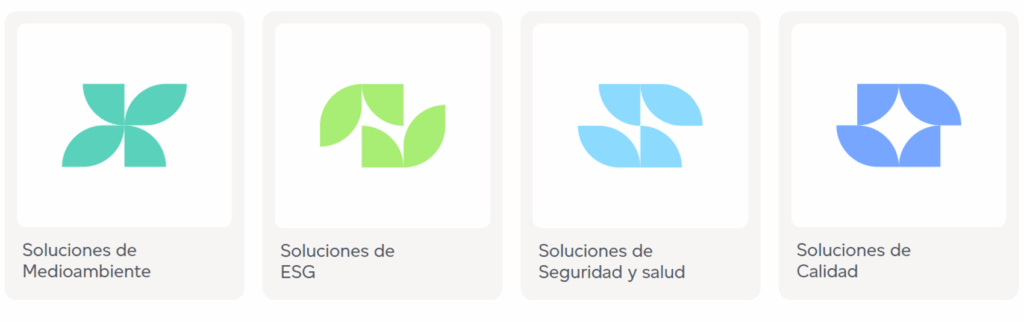
Prodity’s four dimensions integrate Environment, esg, Health and Safety, and Quality processes into a single platform, fostering communication and transparency between areas.
4. Scalability and customization
Every company has different needs. Therefore, the best EHS software is the one that allows you to adapt modules and functions to the size, sector and complexity of the organization. Whether you manage an industrial plant in Madrid or a logistics chain in Santiago de Chile, the tool must grow with you and adjust to your reality.
This is emphasized by our own customers:
“A before and after for our company. Prodity helps us manage everything from a single platform, which saves us time and money. The best part is the customization possibilities and the support in Spanish, which solves problems quickly and efficiently.” (Capterra Review)
5. Data analysis and reporting
Informed decision making requires data that is accurate, up-to-date and accessible in real time. The best EHS software must provide advanced analytical tools to visualize performance in critical areas such as safety, health and environment. This includes customizable dashboards, automatic reporting, comparative graphs and predictive analytics capabilities based on artificial intelligence or machine learning.
Thanks to these functionalities, organizations can anticipate incidents, detect dangerous trends, justify investments in preventive measures and demonstrate their commitment to continuous improvement.
With Prodity’s IA Scout you will be able to generate reports with the required content and format, drastically reducing the time spent on administrative tasks and allowing professionals to focus on what matters most:the safety and well-being of people .
6. Integrations with other systems
Evaluate whether the software can be integrated with your current systems: ERP, HR, CRM or IoT tools. Platforms that enable these connections reduce data duplication, improve traceability and increase overall efficiency. This is especially useful for multi-site companies or companies with complex processes.
We want you to exploit all our functionalities, so Prodity integrates with your corporate tools in an agile and secure way through API.
7. Technical support and accompaniment
It is essential to have a supplier that offers agile technical support, customized training and constant updates. The relationship with the supplier does not end with the purchase: choosing the best EHS software also involves evaluating the after-sales service and support throughout the product’s life cycle.
At Prodity, our team of specialists accompanies you from the implementation phase, ensuring a quick and frictionless adoption. In addition, we offer support in your language, resolving incidents quickly and efficiently so that you always have the peace of mind of having a close ally.
Comparing Market Options: Where to Start
Understanding the criteria is the first step; the second is to apply them to the platforms you have in mind. The EHS market offers a wide range of very different options: Cority stands out in large corporations, although its usability for end users is often a point of debate. Intelex has a broad scope but comes with a steep learning curve. Enablon is geared toward complex corporate environments, with the associated costs and rigidity. VelocityEHS is a leader in safety, but its coverage of quality is limited. SafetyCulture was created for field inspections and excels in that area, though it reaches its limits as a comprehensive management system. Sphera targets large industries with substantial budgets and complex implementation projects. And Zyght, which has a strong presence in Latin America, competes primarily on AI capabilities and rapid deployment. Prodity was created precisely to address what these platforms leave unresolved: truly comprehensive EHSQ management—Safety, Environment, Quality, and Sustainability on a single platform—with the flexibility to adapt to your organization without the costs or complexity of heavier enterprise solutions. If any of these names are on your shortlist, you’ll find a detailed analysis at each link.

Conclusion: the importance of a well-informed decision
Opting for the best EHS software not only ensures legal compliance, but also improves safety culture, optimizes processes and contributes to business sustainability. In today’s competitive market, digitizing environmental, health and safety management is a clear advantage for any company with a long-term vision.
If you are looking for a robust, intuitive EHS platform that allows you to adopt higher levels of maturity in your processes, we invite you to get to know Prodity Software. Its comprehensive approach and commitment to innovation make it an ideal choice for organizations that want to lead responsibly and efficiently.
Better let our customers tell you about it…
Frequently Asked Questions When Choosing EHSQ Software
What criteria should I consider before choosing health and safety software?
Before making a decision, it’s a good idea to evaluate at least the following factors: functional coverage (whether it covers only security or also environmental, quality, and ESG aspects), ease of adoption for different user profiles, integration capabilities with existing systems such as ERP or HR, scalability based on the organization’s size and growth, and the level of support and guidance offered by the provider. Price is important, but the true cost also includes implementation, training, and long-term maintenance. Prodity integrates the four dimensions—Safety, Environment, Quality, and Sustainability—into a single platform, with global support in your language and without the usual extra costs associated with more cumbersome enterprise solutions.
How do the leading EHS platforms compare in terms of ease of use and customization?
There are significant differences. Platforms like Intelex or Enablon have broad scope but come with steep learning curves and offer little flexibility without consulting services. SafetyCulture excels in usability for field teams, but is more limited as a comprehensive management system. Cority is robust, though its interface isn’t always intuitive for non-technical users. Prodity is designed for rapid adoption by all user types—from field technicians to management—with customizable modules that require no custom development and natively integrated AI to reduce the administrative burden from day one.
How to Compare EHS Platforms for Multi-Site Industrial Environments?
In multi-site environments, the critical factors are the centralization of real-time data, the ability to manage different regulations by country or region, and the traceability of incidents and nonconformities across facilities. Platforms such as Sphera or Enablon are designed for large industrial structures, but their implementation is complex and costly. Prodity addresses this centralized management need with greater agility: modular architecture, global support in Spanish, compliance with European and Latin American regulatory frameworks, and integration with existing corporate systems via API. Clients such as Colbún, Naturgy, and Fertiberia manage their multi-site operations with Prodity, achieving significantly shorter implementation times than those of corporate alternatives.
What sets SafetyCulture apart from other EHS platforms like Cority or Intelex?
SafetyCulture began as a digital inspection and checklist tool for field teams, and that’s where it truly shines. Cority and Intelex, on the other hand, are more comprehensive EHS management platforms designed for corporate environments with more complex processes. The main difference lies in scope: SafetyCulture effectively covers day-to-day field operations, but reaches its limits when the organization needs audit management, advanced regulatory compliance, quality, or ESG capabilities. Prodity covers the entire spectrum—including sustainability and GRI indicators—without sacrificing the usability expected of a field tool, and with native AI to automate analysis and reporting.
Which EHS platform scales best for large companies?
It depends on the scale. Sphera and Enablon are designed for large corporations with complex structures, but they require lengthy implementations and substantial budgets. Cority and Intelex are mid-range options with good functional coverage. Prodity offers a modular architecture that allows companies to scale from an SME to a multinational organization without changing platforms or incurring the additional costs associated with more resource-intensive solutions. Its agile implementation model and global support in the customer’s language make it a particularly competitive option for companies expanding internationally, both in Europe and Latin America.
How can you measure the return on investment from implementing EHS software?
The most common indicators include reduced time spent on administrative and reporting tasks, fewer incidents and nonconformities, savings on audits, and regulatory compliance without manual intervention. A specific example: Tubacex reduced the time spent analyzing safety observations from 15 hours per month to less than 1 hour after implementing Prodity, representing a 93% reduction. Beyond the data, the return on investment is also measured by the ability to make faster, better-informed decisions—something that Prodity’s AI agents, such as Action Bot and AI Scout, make possible from the very start.
Which EHS software offers the best value for the money?
Leading platforms such as Enablon, Sphera, and Cority offer advanced features, but at a cost—in licensing, implementation, and maintenance—that is not always within the reach of medium-sized or growing organizations. SafetyCulture is more affordable, but its coverage is more limited. Prodity offers truly comprehensive EHSQ management—Safety, Environment, Quality, and Sustainability—with native AI, global support in your language, and fast implementation times, without the extra costs associated with more cumbersome enterprise solutions. For many industrial organizations, it’s the option that best balances scope, usability, and cost.