


In today’s dynamic industrial environment, it is no longer enough to know what happened, but to know what is going to happen. The integration of Artificial Intelligence (AI) into EHS management is no longer a science fiction promise, but the most powerful tool for safety leaders.
The end of “dead” data
Traditionally, occupational safety has been based on reactive indicators (accident rates). However, according to organizations such as the European Agency for Safety and Health at Work (EU-OSHA), Artificial Intelligence makes it possible to process large volumes of historical data to identify risk patterns before they become incidents. This is what is known as predictive analytics.
How does AI impact the day-to-day life of the preventionist?
- Artificial Vision: Intelligent cameras that detect in real time if a worker is not wearing his PPE or if he is in a risk zone.
- Natural Language Assistants: Tools that allow consulting complex protocols or generating inspection reports through voice commands, eliminating hours of administrative burden.
- Fatigue Management: Algorithms that cross-reference shift and critical task data to alert on dangerous levels of exhaustion in crews.
Digitization with Artificial Intelligence does not seek to replace human judgment, but to enhance it. By automating data collection and analysis, OSH professionals regain their most valuable asset: time to be present where it really matters, in the field.
How does Prodity apply Artificial Intelligence on a daily basis?
Unlike other generic solutions, Prodity has developed specific Artificial Intelligence tools for the real challenges of the EHSQ and ESG sector, focused on three pillars: agility in the field, deep analysis and immediate action.
At Prodity, these tools are available to reach success stories:
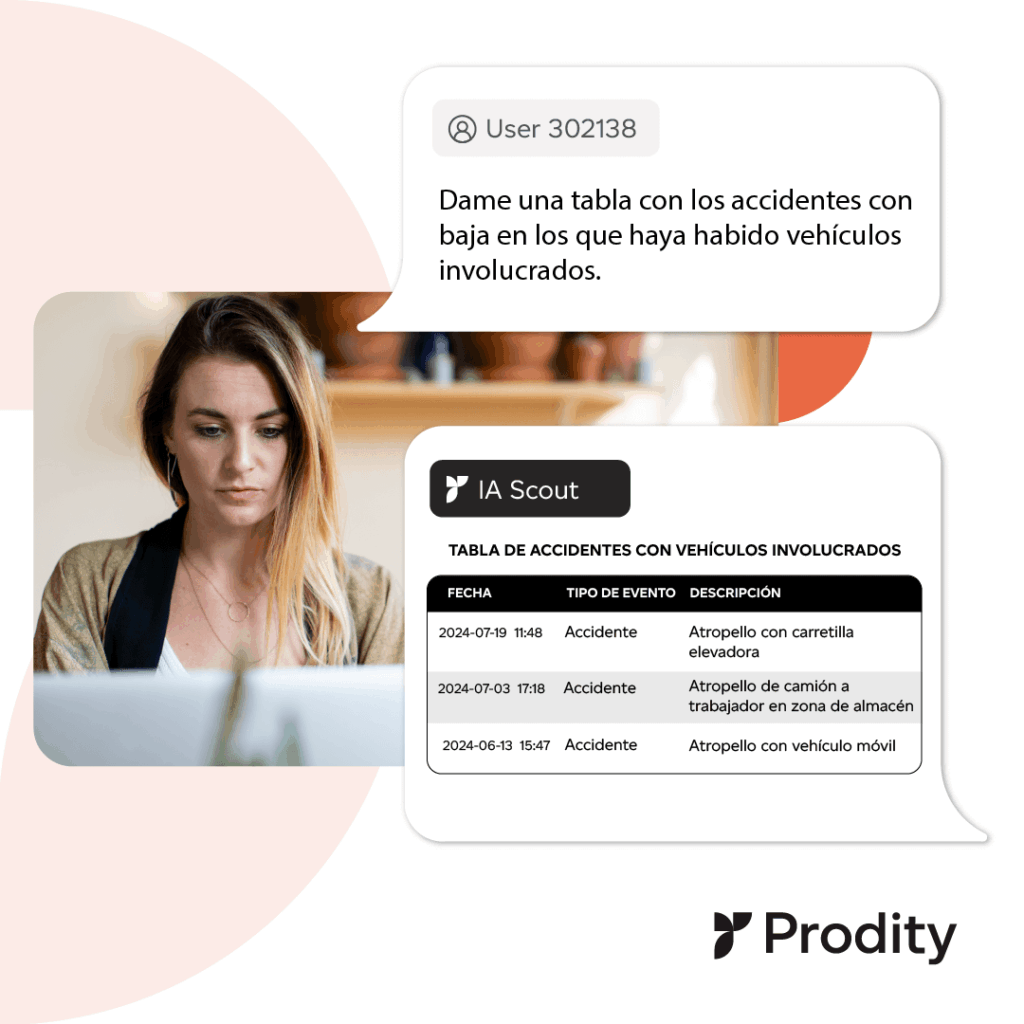
- AI Scout (Talk to your data): You can ask questions in natural language (e.g. “Give me a table of accidents with casualties involving vehicles”) and get answers, tables and actionable graphs instantly.
- FieldVoice (Voice Logging): Facilitates on-the-scene reporting. Workers can record events and observations simply by speaking, using WhatsApp-like audios, which the AI automatically processes and categorizes.
- RelaTiQ (Historical Memory): This tool analyzes your history to find similar events. By detecting patterns and precursors of risk, it allows you to make better preventive decisions based on your own organization’s past experiences.
- Automatic OPS Analysis: Prodity’s AI automatically evaluates the quality of the information in the Preventive Safety Observations (PSO), eliminating human bias and speeding up the analysis. A notable success story is Tubacex, which managed to reduce its PSO analysis time by 93% thanks to this technology.

- Action Bot: Turns any finding or event into a coherent, complete and structured action plan automatically, ensuring that no detected risk is left without a corrective action.
Frequently Asked Questions about Artificial Intelligence in EHS
1. Will Artificial Intelligence replace the job of the risk preventionist?
No, AI acts as a technological “co-pilot” that processes large volumes of historical data to predict real risks. Its function is to detect patterns that the human eye might miss, allowing the professional to focus on strategic decisions and preventive work in the field, saving time and reducing administrative effort.
2. How does Prodity’s AI help to drastically reduce the administrative burden?
The platform automates tedious tasks through tools such as FieldVoice, which allows you to record events and observations by speaking directly from the field with WhatsApp-like audio. In addition, features such as Action Bot automatically turn any event into a coherent and structured action plan , eliminating the need to fill out manual forms.
3. Is it necessary to have advanced knowledge in technology to use tools like AI Scout?
No, the interfaces are designed to be intuitive and easy to use. With AI Scout, any user can explore the information by asking simple questions in natural language and get clear answers, graphs or tables instantly, without the need to generate complex reports or perform manual searches.
4. How does AI help to learn from the organization’s history to make decisions?
Through functionalities such as RelaTiQ, AI finds similar events in the company’s history. This allows learning from past experiences and applying actionable conclusions to current situations, ensuring that prevention is based on solid data and not just intuition.